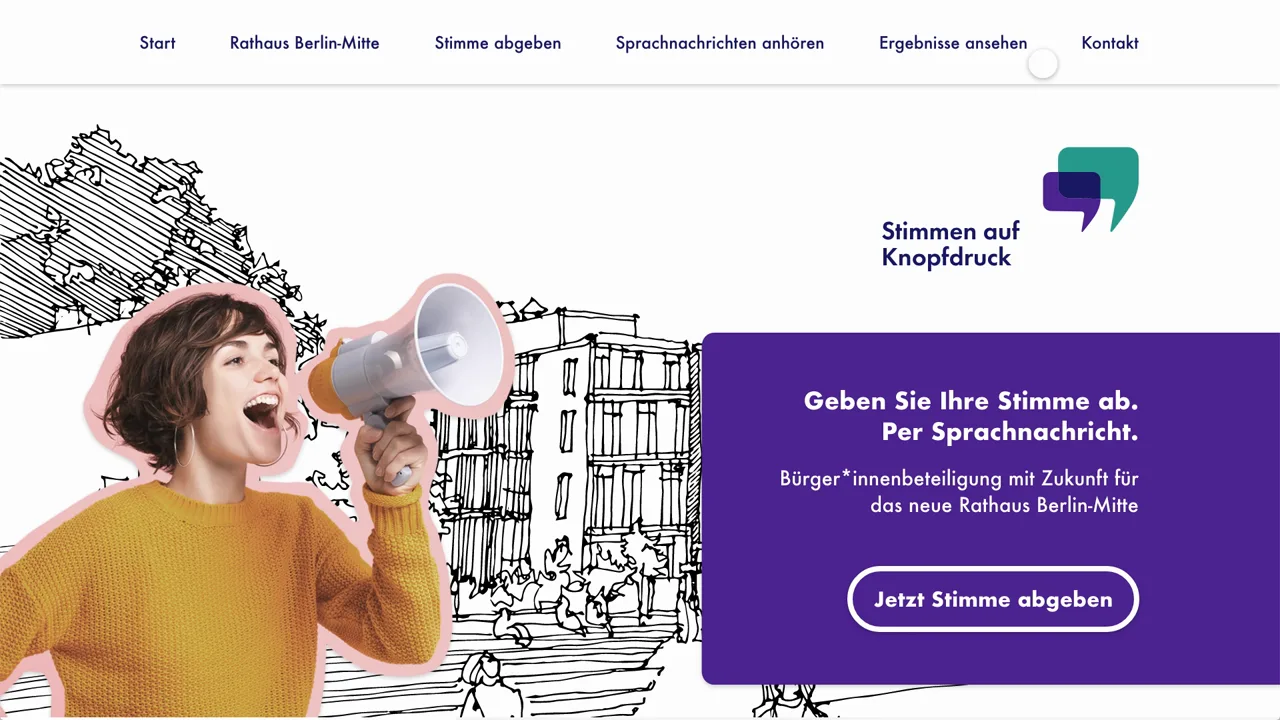
The challenge
How do you gather meaningful qualitative input from a heterogeneous population without excluding people through technical complexity, long forms or institutional language?
The project was developed in the context of the future of Berlin’s central town hall, together with the Humboldt-Viadrina Governance Platform and commissioned by the Berlin Senate Administration.
The challenge was not simply to collect opinions.
It was to create a participation experience accessible enough for very different people to actually use.
The insight
Participation only works when taking part is easier than staying silent.
Traditional participation formats often ask too much before they give anything back.
- Time.
- Attention.
- Confidence.
- Language.
- Technical literacy.
The central idea was therefore radical in its simplicity:
Let people speak.
Literally.
The intervention
A hybrid participation system combined:
The result was not a single channel.
It was a communication architecture.
My role
My work focused on concept development, communication and the digital experience.
I helped translate the participation challenge into an accessible communication system and developed the website that enabled people to contribute their voices.
The core task was the same one that still drives my work today:
Reduce complexity without reducing meaning.
The impact
The collected voices became an input for the further planning process.
More importantly, the project demonstrated a principle that extends far beyond public participation:
Good systems do not force people to understand the system first. They make meaningful interaction feel natural.